How to Balance Real Estate Classes With a Full-Time Job
Table of Contents
- Why Real Estate Classes Can Fit Around a Full-Time Job
- Build a Real Estate School Study Schedule That Matches Your Work Shift
- How Long Does It Take to Get a Real Estate License While Working?
- Choose Online Real Estate Classes That Fit Your Work Hours
- Real Estate Exam Study Tips for Busy Professionals
- Set Boundaries With Your Employer and Family Before You Enroll
- Plan Your Licensing Costs and Avoid Surprises
- Frequently Asked Questions
Last Updated: October 17, 2026
Why Real Estate Classes Can Fit Around a Full-Time Job
You can finish real estate classes while working full time. The trick is not finding extra hours in the day. It is matching your coursework to the hours you already have.
Most people picture a classroom with fixed times. That model is largely gone.
The work is real, though. Pre-licensing courses run dozens of hours, and the licensing exam demands focused preparation. But thousands of working adults complete the coursework every year without quitting their jobs.
Below, we break down exactly how to schedule your real estate classes around your shift, budget your costs, and protect your study hours from work and family demands.
Build a Real Estate School Study Schedule That Matches Your Work Shift
A real estate school study schedule works best when it mirrors your actual week, not an ideal one. Pick fixed study blocks that fit your shift and treat them like appointments you cannot cancel.
Here is how that looks by shift:
| Your Shift | Best Study Windows | Weekly Target |
|---|---|---|
| Standard daytime | Two weekday evenings plus Saturday morning | 6-8 hours |
| Early morning start | Afternoon block plus Sunday afternoon | 6-8 hours |
| Evening or night shift | Late morning after sleep, plus one weekend block | 6-8 hours |
| Rotating shifts | Short daily sessions, longer block on days off | 5-7 hours |
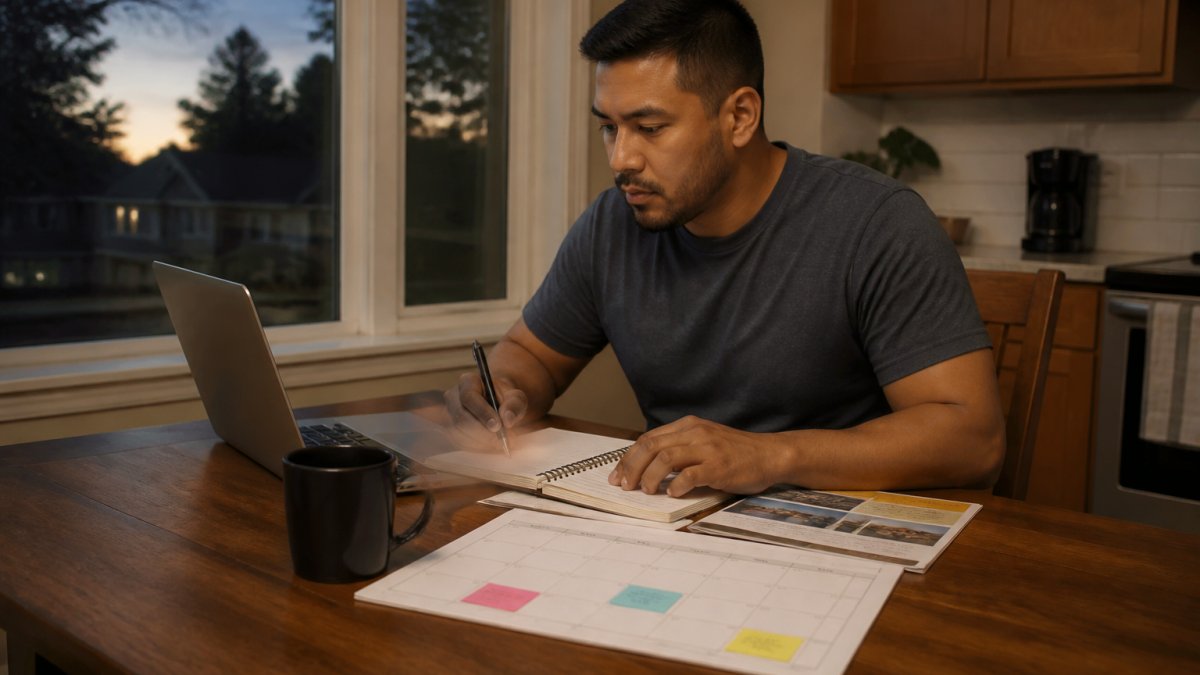
A common mistake is planning marathon weekend sessions. Two hours, four days a week beats one eight-hour Saturday every time. Short sessions keep the material fresh and make it easier to recover if you miss a day.
How Long Does It Take to Get a Real Estate License While Working?
Most working adults finish pre-licensing coursework in two to four months. The exact timeline depends on your state's required course hours and how consistently you study.
State requirements vary widely. Some states require 60 hours of pre-licensing education, while others require 75 or more. Check your state's real estate commission for the exact number before you enroll.
Here is the math. If your state requires 60 hours and you study 7 hours a week, you finish the course in about nine weeks.
A realistic total: three to four months from enrollment to license, assuming steady effort. Push it faster by adding a weekend block. Slow it down during busy work seasons without losing your progress.
Choose Online Real Estate Classes That Fit Your Work Hours
Online real estate classes are the practical choice for anyone working full time. The format matters more than the brand, though. Look for three things: self-paced lessons, instructor access, and progress that saves automatically.
Those three features solve the biggest problems working students face. Self-paced lessons mean a missed week does not derail you. Instructor access means you get answers instead of guessing. Saved progress means a crashed browser never costs you a chapter.
The real difference between course formats comes down to accountability. A fully self-paced course with no instructor contact is cheap and lonely. A course with a real teacher behind it costs a little more but keeps you moving.
Our Florida 63-hour pre-license course and Georgia 75-hour pre-license course both run $199.00 and include instructor access from any device. You can study at 2 a.m. or on your lunch break, and an instructor is there when you log in.


Real Estate Exam Study Tips for Busy Professionals
Real estate exam study tips for working adults all point to one principle: practice under exam conditions, not just reading. Passive review feels productive but does not build recall. The difference between a first-attempt pass and a retake is usually how early you started testing yourself, not how many hours you logged. Rigorous self-testing creates the mental stamina necessary for long-term success, which is a vital component of avoiding real estate burnout as you transition into your new career.
Alabama 60-hour Real Estate Pre-license Course →
Build a Four-Week Exam-Prep Block
Once your pre-licensing course is done, plan a dedicated four-week exam-prep block before you schedule the test. Here is a schedule that fits around a standard daytime shift:
| Week | Focus | Weekday Sessions (2 x 45 min) | Weekend Block (3 hours) |
|---|---|---|---|
| 1 | Diagnostic and weak spots | Full practice exam, review wrong answers | State law and contract basics |
| 2 | Contracts and agency | Flashcards on key terms | Practice exam #2, review |
| 3 | State-specific rules | Quiz commute time on state rules | Practice exam #3, review |
| 4 | Full simulations | Timed mini-exams | Full timed practice exam, final review |
If you work evenings or rotating shifts, keep the same sequence but move the weekday sessions to late morning after sleep. The order matters more than the clock time.
Use These Tactics
- Take a full practice exam in week one. Do not wait until you feel ready. The diagnostic shows you exactly where to spend your remaining hours.
- Review wrong answers first. Your mistakes teach you more than the material you already know. Keep a running log of missed concepts and revisit it before each new practice test.
- Use dead time. Quiz yourself on state-specific rules during your commute, on a lunch walk, or while waiting for a shift to start. Free flashcard apps make this easy.
- Study in 25-minute blocks. Short focused sessions beat long distracted ones. A 25-minute block before work is worth more than a two-hour session you keep postponing.
- Explain concepts out loud. If you cannot explain a term simply, you do not know it yet. Teach a concept to a family member or talk it through to yourself.
- Simulate exam conditions. Turn off notifications, set a timer, and take at least two practice exams under the same time limit as the real test.
The licensing exam leans heavily on state law and contract basics. Those topics reward repetition, not cramming. Spread them across your weekly blocks so they stay fresh.
Set Boundaries With Your Employer and Family Before You Enroll
Boundaries decide whether your study plan survives contact with real life. Set them before you enroll, not after your first missed week.
With your employer, keep it simple. You do not need permission to study, but a heads-up helps. Tell your manager you are taking a course and ask about a consistent schedule. Many employers respect the ambition, and some will help protect your lunch hour.
With family, be specific. "I need quiet time" fails. "I study Tuesdays and Thursdays from 7 to 9" works. Put the blocks on a shared calendar so nobody schedules over them.
- Agree on one weekend block that stays protected
- Trade one family obligation for study time, openly
- Tell your household what finishing means for all of you
- Plan a small reward for each completed course module
A common mistake is hiding your coursework until it is done. Family support makes the schedule stick. Loop them in early.
Plan Your Licensing Costs and Avoid Surprises
Licensing costs add up beyond the course fee. Plan the full budget before you enroll so a surprise payment never derails your progress. Most working students find the total is smaller than they feared once they see every line item in one place.
The Full Cost Picture
Expect these line items. Dollar figures vary by state and provider, so treat the ranges below as planning estimates and confirm exact amounts with your state's real estate commission and your course provider.
| Cost | Typical Range | What It Covers |
|---|---|---|
| Pre-license course | $150.00-$400.00 | Required education hours, varies by state |
| State application fee | $25.00-$100.00 | Filed with your state's real estate commission |
| Fingerprinting and background check | $30.00-$75.00 | Required in most states before licensing |
| Licensing exam fee | $30.00-$100.00 | Paid when you schedule your exam |
| License activation | $50.00-$150.00 | Paid to your state after you pass |
| Continuing education (first renewal) | $50.00-$150.00 | Required to renew your license |
A realistic total for the first license cycle, including one renewal period of continuing education, commonly lands between $400.00 and $900.00 depending on the state. That is the number to budget, not just the course price.
Course prices vary by provider. Our Alabama 60-hour pre-license course and Tennessee 60-hour pre-license course both cost $199.00, which keeps the education portion predictable. Check your state commission's website for the exact application and exam fees, since those figures change and vary by state.

Spread the Cost Across Your Study Weeks
Add up every fee before you enroll and divide the total by your expected study weeks. If your total is $600.00 and you plan to study for 12 weeks, your real cost of getting licensed is about $50.00 a week. Framed that way, the commitment is usually smaller than people fear and easier to plan around a paycheck.
Two practical moves help:
- Pay the course fee first, then set aside a small weekly amount for state fees. By the time you finish the course, the exam and application money is already there.
- Ask your provider about payment plans. Our Easy Pay Plan spreads the course cost so a single payment does not land in the same month as rent.
Frequently Asked Questions
Can I take real estate classes while working full time?
Yes. Most state-approved pre-license courses are available online and self-paced, so you can complete the required course hours around your work schedule. The key is building a weekly study plan and protecting those hours. For example, a 60-hour course spread over 10 weeks needs about 6 hours per week, which fits into two weekday evenings plus a weekend morning. Choose a course format with instructor access so you can ask questions when you get stuck instead of losing a week.
How many hours a week should I study for real estate classes?
Plan for 6 to 10 hours per week if you want to finish a 60- to 75-hour pre-license course in two to three months. That breaks down to roughly one hour on three weeknights plus a three- to four-hour weekend block. If your work schedule is unpredictable, aim for the lower end and extend your timeline rather than skipping weeks. Consistent short sessions beat one long weekend cram session because you retain more of the material for the licensing exam.
How do I make a study schedule around a full-time job?
Start with your fixed commitments: work shifts, commute, family duties, and sleep. Then block two or three recurring study windows per week and treat them like appointments. Match the format to your energy: read or watch lectures in the morning if you focus better then, and save practice questions for evenings. Use small gaps, like a lunch break or commute, for flashcards. Review your schedule every Sunday and adjust before the week starts instead of after it falls apart.
What should I do if I fall behind in my real estate classes?
Falling behind for a week is normal. The fix is to reschedule rather than quit. Add one extra study block the following week, tell your instructor where you left off, and focus on the next lesson instead of trying to catch up all at once. If you miss more than two weeks, recalculate your target completion date and extend it. Most self-paced courses let you work at your own speed, so a short pause does not erase your progress, but a long gap makes it harder to restart.